

You sign in to a website through Tor. The website knows which account signed in. The first relay knows which Internet Protocol (IP) address connected to it. Those two pieces of information belong to the same visit. What would it take for an observer to put them together?
Start with a circuit through a guard, a middle relay and an exit to a website using Hypertext Transfer Protocol Secure (HTTPS). The table describes one observer at a time and assumes the client and site are working as intended. Tor design paper, Threat Model , HTTPS encryption and Tor
| Observer | What it can see directly in this example |
|---|---|
| Guard relay | The connecting IP address and the next relay, plus traffic timing and volume at the guard |
| Middle relay | The adjacent relays’ addresses and the timing and volume of traffic on those links |
| Exit relay | The previous relay, the requested destination, and the timing and volume of the stream. HTTPS keeps the request contents encrypted here. |
| Website | The exit’s IP address and the request after decryption, including any account or cookie the browser sends |
A network provider near the client can observe the first link. It can see the source address, the first relay and traffic timing on that link. A second observation point changes what it might infer.
One trace, then two traces
An observer who can see the client-to-guard and exit-to-website links can compare those traffic traces. A guard and exit sharing observations could make a similar comparison. Suppose the traces show a short upload, a pause and a larger download at nearly the same time. The two traces below are illustrative. Bar height represents the amount of data in an interval.
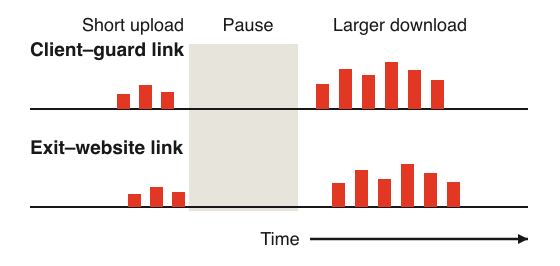
The similarities are evidence that the traces might belong to the same flow. Other flows can look similar. This is traffic correlation, an inference about a visit from timing and volume. To link the source address to the account in our opening example, the observer also needs evidence from the application, such as the website’s record of who signed in on that connection. Tor Project on traffic confirmation
An observer watching just the client side can try a different inference. Website fingerprinting compares patterns in encrypted traffic with examples of known activity. The result is a guess about the destination based on a model. Browser fingerprinting uses properties exposed by the browser to the website. It occurs at the application end and uses different evidence. Research on website fingerprinting , Tor Browser fingerprinting protections
The same request can disclose identity elsewhere
With plain Hypertext Transfer Protocol (HTTP), an exit can read the unencrypted request on the way to the website. With HTTPS, the website still decrypts what you send it. Logging in connects the request to the account. If the site already knows who owns that account, it learns who made the request without seeing the original IP address. Tor Browser guidance on logging in
A compromised device can observe the request before encryption. An application that connects outside Tor can expose its source address directly. Tor Browser safety guidance
For an onion service , the rendezvous relay sees which circuits it joined and when traffic crosses. In the ordinary anonymous service model, the two original addresses are behind their respective circuits, and the payload is protected by keys shared by the client and service.
Go back to the sign-in. The site can attach the request to the account immediately. Linking the account to the client’s network address requires an additional source, such as both traffic traces together with the site’s record or information from the device.