
It was late 2022. The world was on the brink of the ChatGPT revolution, but we didn’t know it yet. I was a developer with a burning desire to ship a SaaS, and I decided to tackle a problem that felt massive: website building.
My idea? EasyPageGo. Imagine Notion, but for building full websites.
The “Simple” Idea
The concept was straightforward: a user logs into a dashboard, drags some blocks around, and clicks “Publish”.
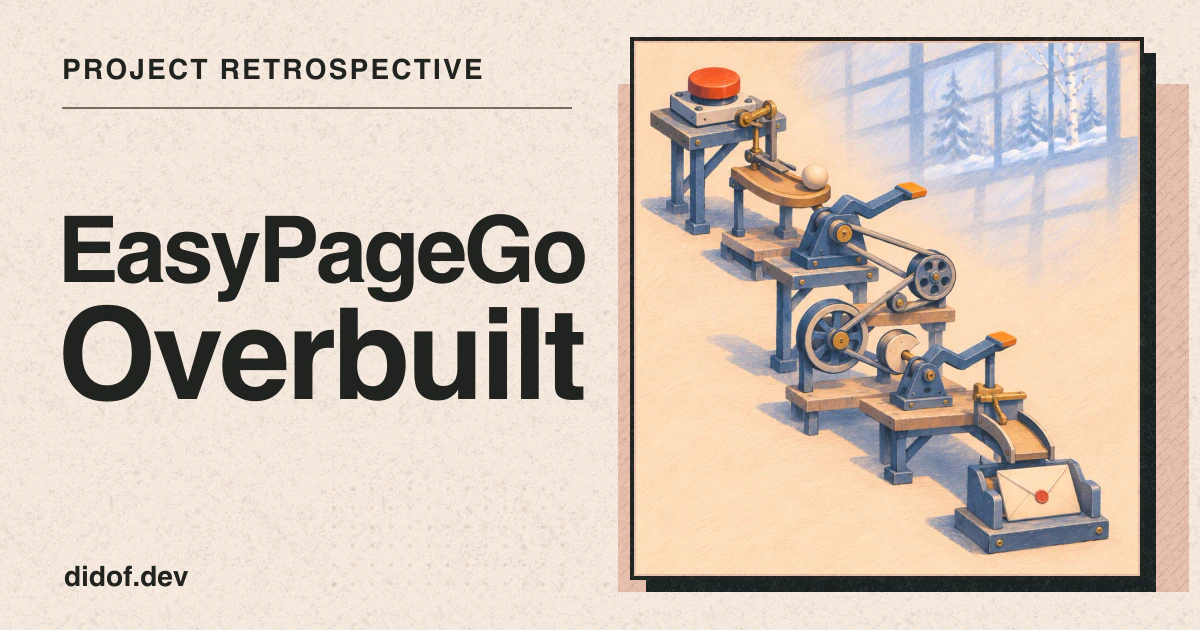
But beneath that simple “Publish” button lay a monster of complexity. I didn’t just want to host static HTML. I wanted to give users the power of a modern web framework. So, I architected a solution that, in hindsight, was a beautiful Rube Goldberg machine.
The Architecture of Madness
Here is how it worked:
- The Dashboard: The user defined their site structure. This generated a massive JSON object describing every page, component, and style.
- The Trigger: When they clicked “Publish”, this JSON was sent to my VPS.
- The Builder: I had a custom Docker image ready. This container would spin up, receive the JSON, and inject it into a SvelteKit template.
- The Build: Inside the container, a script would run
npm run build. SvelteKit would churn out a static site. - The Delivery: The container would zip up the build folder.
- The Email: Finally, the system would email the zip file to the user.
Yes. I was spinning up a Docker container for every single user edit, building a production app, and emailing zips.
Why It Failed
I knew it was doomed a few weeks in, but I kept pushing. Why?
1. The Technical Challenge
The difficulty was enormous. I had to master VPS management, Docker orchestration, and automated build pipelines. It was a fantastic learning ground. I refined my database knowledge and learned how to manage resources when ten containers spin up simultaneously.
2. The Market “Titans”
I was entering a space dominated by WordPress, Wix, Squarespace, and Webflow. These weren’t just competitors; they were ecosystems. I was a guy with a Docker script.
3. The Pre-AI Era
This was just before AI made code generation trivial. I was trying to manually build a logic engine that AI can now generate in seconds. I was solving yesterday’s problem with tomorrow’s complexity.
The Lesson
“Solved a problem no one had with complex tech.”
EasyPageGo taught me that technical prowess doesn’t equal product value. Users didn’t care that I was using SvelteKit or Docker. They just wanted a website.
I learned to respect the “boring” path. I learned that distribution matters more than the build pipeline. And most importantly, I learned to recognize when I’m building a feature for the user, and when I’m building a challenge for myself.
EasyPageGo is dead, but the lessons and the shell scripts remain.